
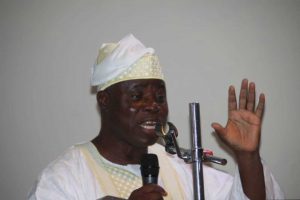
TEXT OF AN ADDRESS AT VOICE OF REASON TOWN HALL MEETING BY
I have the profound honour of being selected to voice the reason of all the other eminent members of our body. It is a very rare privilege of a life time to be so given the task of addressing this gathering of the entire political leadership of the YORUBA NATION as the next republic beckons. In taking up this historic duty, I must let you bear in mind that the very good ideas being shared that may resonate are a collective, while any deviations and errors are my personal responsibility.
Very few will doubt the assertion that we are truly in perilous times. We are at a time that calls for sober reflection on the place of our ethnic nationality in what has become the Unitary Government of Nigeria. Yet to the discerning, it has not always been the way we are now.
It is quite correct to state that we have never been disposed to being part of the so-called Power at the Centre, since the advent of the Nigerian nation. In 1959, 1979, 1999, the mainstream segment of the Yoruba society was content with being on our own, believing in our own self determination and innate capacity to take charge of our destiny. Thanks to the epoch-making administration and the sagacity of our leaders during the period 1954 to 1962.
But on the account of the pointed demands by some tendencies amidst us, we finally succumbed and became part of the Northern-flavoured APC coalition at Abuja in 2015. But the quest obviously unravelled within 6 months and the arrowhead of our participation quickly became persona non grata in the chamber of authority at the Villa.This could be glossed over by the less discerning, but the same treatment was meted out to our South East brethren in 1961 and 1980 respectively. So we are now at the cross roads. We can only be numb to the subsisting imperatives of the impending electoral contest at our great peril.
It is important to note that our intellectual, economic and political domination have slowly, but surely been creeping upon the Yoruba Nation since the golden era years that ended in 1966. Only those with uncommon understanding are capable of seeing the dangers that have come upon us as Yorubas in the context of Unitary Government of Nigeria. Our heritage and core values have been and are still being appropriated before our very eyes while we stand akimbo: without a coherent framework of strategic responses.
In the social media, many of our compatriots to the East for instance, don’t seem to have any feelings for our sensibilities unapologetically. All the documented positive testimonies of sacrifices made in their favour by Adekunle Fajuyi, Wole Soyinka, Sam Aluko does not seem to count for anything. The tale of Subomi Balogun and Alex Ekwueme and the general handling of their property during and after the war is glossed over. Ojukwu family holdings and those of all others in our region were kept in tact. Similarly, the positive world-view of S.G. Ikoku, MCK Ajuluchukwu, Oyibo Odinamadu and Odia Ofeimun among their own brethren in our favour is scornfully put down for no reason. None of them has ever been molested or killed on our land on the account of who he/she is or language spoken.
Yet, in their hearts and minds, our brethren to the East would rather engage with those who maim, kill and plunder their lives without let throughout the years of Nigerian history. Regardless, they find comfort and flourish in our own territory. They point to only “one event of being cheated” during the so-called election of 1952, without any mention of all acts of Yoruba accommodation of their attitudes for years subsequently. Even the UPGA linkage of 1964 was observed more in breach. As a result our care free attitude, it has now become pass time for us to be taunted with the claim that Lagos, and indeed the Yoruba territory is no-man’s land. Quite handily, they won elections to represent themselves on our territorial land. Our business spaces and proud psyche are seemingly violated as we stand akimbo.
As for some of our neighbours to the north, they are adept at taking advantage of their religious affinity with some of our people. They claim and utilize the commonality of the Muslim religion to assimilate and control, despite not being amenable to worshipping under the authority of an Imam of Yoruba extraction. Is the Alafin of Oyo or the Awujale of Ijebu Ode not far more than eminently qualified to lead the Nigerian Council of Islamic Affairs. But permanent authority lies elsewhere without any challenge so far: food for thought.
Our northern brethren always feel comfortable using and deploying Yoruba intellect and professionalism to manage the affairs of the government and even their personal business entities, but only in a patronising subordinate arrangement. Is this not as clear as the sky?
The Yorubas were short-changed during the Olusegun Obasanjo era through his nebulous patriotism that is ungrounded in reality. If the Jonathan era was insolent in its quest to deliberately insult the sensibilities of the Yoruba nation, the Buhari regime has become an anticlimax in the way the feelings of all Nigerians are being trampled upon with impunity. What do we make of the events of the past week? How shall we fare moving forward from now until 2023?
Many will focus on the simplistically trivial: a little stretch of paved road from Mowe to Moniya? Rail line with antiquated coaches dumped on us by China? Or a new paint on Lagos Airport wall. All on debt to China. But as free born citizens, are we content with hand outs and hand downs of crumbs from our masters table? Is that all we are worth?
We must juxtapose the above with the question: is the Yoruba nation and her peoples strategically safe under the regime with the following appointments and headships made with deliberate impunity:
1. Chief of Army Staff, General Tukur Buratai – Borno
2. Chief of Air Staff Abubakar Sadiq – Bauchi
3. Director General of DSS, Yusuf Magaji Bichi – Kano.
4. Director General of NIA, Rufaâ I Abubakar – Katsina
5. Inspector General of Police, Ibrahim Ahmed – Nasarawa
6. Commandant General of Civil Defence Corp, Abdullahi Muhammad – Niger
7. Comptroller General of Immigration, Muhammed Babandede – Jigawa
8. Comptroller General of Prison Services, Jaâfaru Ahmed – Kebbi
9. Comptroller General of Customs, Hameed Ali – Bauchi
10. Minister of Defence, Mansur DanAli – Zamfara
11. Minister of Internal Affairs, AbdulRahman Dambazau – Kano
12. Chairman of EFCC, Ibrahim Magu – Borno
13. National Security Adviser, Muhammed Monguno – Borno
14. Chief of Defence Intelligence Agency, Muhammad Usman – Kano
15. Chief of Naval Staff, Vice Admiral Ebok Ibas – Akwa Ibom
16. Chief of Defence Staff: Maj. Gen. Abayomi Olonisakin – Ekiti
17. National Drug Law Enforcement Agency (NDLEA), Col. Muhammad Mustapha Abdallah rtd – Kano
18. Supreme Court: Tanko-Mohammed – Bauchi
19.Appeal Court: Zainab Bulkachuwa – Gombe
20.Federal High Court: Abdul Kafarati – Bauchi
21.Justice Minister: Abubakar Malami – Kano
22. National Financial Intelligence Unit: Hamman Modibo Tukur – Adamawa
Suffice it to state that the quest to futuristically anticipate war may be the rationale for the total appropriation of the entire military architecture of the country by the North, as per the following:
Equally of importance is the total appropriation of all tertiary military and para-military institutions for concentration only in Northern Nigeria, as follows:
1.Nigeria Police Academy, Kaduna – Kaduna State
2.Nigeria Police University, Dutse – Jigawa State
3.The Police Academy, Wudil – Kano State
4.Nigeria Military University, Biu – Borno State
5.Nigeria Air Force University, Kaduna – Kaduna State
6.Air Force Institute of Technology – Kaduna
7.Nigeria Defence Academy, Jaji, – Kaduna State
8.Command and Staff College, Jaji – Kaduna State
9.Nigerian School of Infantry, Jaji – Kaduna State
10.Nigeria War College – Abuja
11.Nigerian Institute for Policies and Strategic Studies – Jos.
12.Nigerian Civil Aviation College – Zaria.
Whereas, all these institutions are being promoted and run with funds drawn from Tertiary Education Fund (TETFUND) a body of the Unitary Government of Nigeria that derives funds largely from corporate taxes by companies that principally operate in the Southern Region.
Equally noteworthy is the fact that those who were facilitated into Ahmadu Bello University through quota and federal character watered down WAEC/JAMB scores during the 60’s and 70’s years are today made to sit atop of those that were admitted into the Universities of Ibadan, Ife and Lagos with resounding distinctions. The entire complement of those heading the Ministries, Departments and Agencies: NUC, NBTE, NCCE, TETFUND are Professors of Northern origin. We have sheepishly acquiesced to all these anomalies for far too long to our detriment. Regardless, it is in the supreme interest of our Northern brethren to immediately do away with the perception that their young children are lacking in abilities and capacities to compete with others on merit in all spheres of endeavour. The aura of 7% scores displacing those with 70% has persisted for too long without repudiation.
The Apapa Port complex is the jewel of our territory. But despite its economic value, the unfeeling Nigeria State has rendered it blighted and decayed. The pointed order by Vice President Osinbajo that the Port debacle be fixed has so far been scornfully ignored. Yet we are quiet? The NPA is headed by a Hadiza Usman.
Can we ever thrive in an atmosphere where the Head of the Nigerian State and his appointed Minister of Education have not found it fit to utter a single word or sentence so far in the months that ASUU and ASUP has been on strike, with all our youths marooned? If other ethnic nationalities of Nigeria don’t care, is the world view of the Yoruba Nation not about education? education and education for development? Is our utter silence wise?
Of more critical importance is the inability of our children after being educated in and outside Nigeria at great expense to end up in badly managed economy that can not provide employment for them, It is tragic, for many who have invested all their resources and earnings to educate their children to find themselves still fending for their children unemployed five or more years after graduation from university. A significant limitation to growing our industries is the constitutional restriction against states from generating power and the centralisation of power transmission rendering impotent state governments from intervening in the sector. Similarly a centralised policy framework has rendered the whole industry though privatised comatose. A decentralised power architecture will free the states or regions to unlock the potentials offered by more investments and better regulatory regimes.
Along with these is the centralisation of resources with centre keeping 55% of all federally collected revenues which are derived disproportionately from the South but disproportionately allocated to the North through a revenue formula skewed through a political configuration brought about by military fiat. The equality of state and local government elements in the revenue allocation formula has become clearly a constant reminder of the injustice that the military has bequeathed to the nation. A Value Added Tax that was introduced to replace Sales Tax administered and kept by the states with the promise that it will be distributed wholly on the basis of derivation, net of expenses of administration, was also by military decree turned into largesse to be distributed through the pernicious revenue allocation formula that virtually makes states from where the bulk of the tax is derived an insignificant recipient and those contributing next to nothing the major beneficiaries. In essence, we have a tax structure that encourages states to be unproductive and deprive productive ones the revenue to sustain the infrastructure that generates the revenue.It is a tax regime that will lead to ruin and poverty. The collapse of the roads to the nation’s premier Ports in Apapa and Tin Can Island is a poignant reminder of the evil of the dysfunctionality of the centralisation of functions and revenue. For everyday we do not restructure, we literally are killing the golden hens that lay our national eggs.
The foregoing is the foundation of the clarion call for a reconfiguration of the geopolitics and fiscal framework of Nigeria. This is not mere polemics as asserted glibly by others. Rather it ought to be an existential situation for us in the Yoruba Nation. There is need to immediately transform the Unitary Government of Nigeria. Any further delay in acting on this imperative is detrimental and dangerous.
In concluding this section of my presentation, I must state that the picture of distrust and the seeking of unfair advantage painted herein matters ONLY in a unitary government in which everyone is welded together by force. Whereas, in a federal structure, we need not like each other at all. We need not do things together intimately. It is possible to be different and yet co-exist. Everyone can proceed on her own voyage in pursuit of development objectives without being held down by others, outside her territory. This indeed the basis of the quest for restructuring into a federal system.
Several seemingly knowledgeable persons have feigned ignorance of what restructuring meant or entails. One therefore need not be weary of stating the very obvious until everyone becomes aware. Whereas we have been restructuring since the advent of the Nigerian nation in 1914. Two phases of our restructuring quest is obviously discernible.
The first phase was from 1914 to 1966. Through various constitutional conferences and consultations (among our founding fathers, the colonial or pre-independence epoch – which covers 6 constitutional instruments – 1914, 1922, 1946, 1951, 1954 and 1960), we went from no structureat all to a flavour of federal structure in 1954. This agreed framework that must have been unique to our environment was applied with minor changes until 1966. Every part of Nigeria was able to proceed with her development agenda. The positive competition of the time brought the very best of development in all the 3 (4) regions. It bears no repetition here.
The second phase started with the abrupt swing of the pendulum in the direction of what could now be regarded as the Nigerian flavour of Unitary System of Governance (post-independence constitutional epochs; encompassing 3 instruments – 1963, 1979 and 1999). This took the form of
1. fiscal changes (revenue generation and sharing methods): Derivation Formula, Royalties and VAT sharing frameworks; and
2. balkanisation of territories (creation of States and Local Governments): 3 to 4 Regions, 12, 19, 21 and 36 States; centralised take over of Local governments and it embedding in the Federal Constitution that was deliberately made immutable.
While phase I at every turn was carried out by consultation and consent, all the steps during phase II were carried out by gun wielding rulers of Northern Extraction. In 2019, we are now at the junction of a full blown Unitary System of Government, whilst being erroneously called out as a Federal System. From this day onward, lets lift the veil off what we have in operation. In Yoruba ethnology, names have meaning to the extent that it determines character. So the words out our lips from this day onwards should now be:
The Unitary Government of Nigeria.
The historic duty we have now is to commence the quest to swing the pendulum once again in the way of getting Nigeria to be a Federation. For the avoidance of doubt, Federalism is a design and flavour of a governance system that results in balance and equivalence of rights to self determination among all peoples living under the flag of a nation. There is nothing true or false about whatever is fashioned out, once it is acceptable and indeed accepted by the federating units.
The 1999 Constitution has been an albatross on our collective psyche for reasons much more fundamental than those usually canvassed by everyone: “the we the people” preamble was false. Here, I rely on the critical appraisal by Ozodi Osuji (2007) as paraphrased hereunder.
The contemporary question on the lips of all Nigerians has been what restructuring of Nigeria entails in real terms. There has been a lot of chatter especially in the media space with so much lack of clarity on such terms as fiscal federalism, parliamentary system, regionalisation, etc. Outright calls have been made for return to the 1963 Constitution that very few have ever sighted.
But thanks to the Voice of Reason: a group of nationalistic and progressive personalities whose singular mission is to provide ideas and solutions based on foundations of intellect; we now have a document that painstakingly specifies what sort of governance arrangement will be of help to uplift Nigeria and all her peoples.
The form and format of a restructured Nigeria is embodied in the Draft of the Constitution that was first unveiled to the public at an event in Lagos on July 28, 2018. If and when approved eventually after due processing with possible amendments through the democratic space, we may well be on the way to doing the best for ourselves in the comity of worlds nations.
|
Is our Nation Fair to Everyone? |
|
In the end, we shall ask ourselves the following questions of our proposed memorandum of understanding – the Constitution that will lead to the re-birth of our nation: Nigeria. 1. Is it the truth?
2. Is it fair to all concerned?
3. Will it build goodwill and better friendships?
4. Will it be beneficial to all concerned?
These were The Four-Way Test set in the early 1930s by Herbert J. Taylor as he then sought to save the Club Aluminium Products distribution company (USA) from bankruptcy; as adopted by the Rotary Club International in 1940. |
The introductory section of the published draft document contains the highlights of the principal imperatives proposed for a re-configured Nigeria. I hereby set out the other salient features of the document that hopefully will restore the faith and loyalty of everyone and gradually bring harmony of aspirations across Nigeria:
The central thrust of the draft document is minimal government, such as would result in the reversal of the 70/30 ratio of public expenditure towards serving the needs of public servants as against the generality of Nigerians.
(i) 55% Derivation
(ii) 30% to the Distributable Pool Account
(iii) 15% to the Federal Government: Article 142(4).
26In view of the pervasive assimilation of corruption and corruptive tendencies, the Voice of Reason draft should of necessity contain several provisions that rise to the level of the challenge posed to the society. Of course, the political class that are the prime beneficiaries of the present order will fight against these ideas. But it is left to the critical mass of society to exercise controlling authority by prevailing on what would be the good for all.
(1)Government at all levels shall abolish all corrupt practices and abuse of power.
(2)All public officers’ asset declarations shall be available for scrutiny by the public and shall be publishable in the mass media;
(3)All investments held by every public officer in any profit making enterprise shall be held in a blind trust; while tax clearance certificates off all public officers shall be available for public scrutiny and shall be publishable by the mass media;
(4)No public officer shall operate a bank account or own any form of movable or immovable asset outside of Nigeria, unless fully disclosed prior to and after the period of public service;
(5)All gifts in whatever form made to the public officer and or to his/her blood relations shall immediately be disclosed to the appropriate institution of government that shall be designated by the National Assembly or the Regional/State legislature. Retention or compulsory donation to the State by the public officer shall be at the discretion of such an institution whose decision shall not be interfered with by any other person or body.
(1)In cases of corrupt practices, criminal breach of public trust, plundering of public funds and resources, with prima faciecase having been established by the courts of original jurisdiction, the doctrine of the accused being assumed to be guilty until proven innocent shall subsequently apply.
(2)A determination of prima facie case against anyone in accordance to sub-article (1) herein shall serve as the ground for their temporary separation from public office.
(3)The guilty until proven innocent doctrine being an extraordinary provision to cure an extraordinary malaise of the times shall expire within the generation of 30 years after the effective date of this constitution.
(4)For the avoidance of doubt, there shall be no immunity for any person in any position against criminal prosecution.
Finally, the 1999 Constitution has 320 Verbose Articles: a gold mine for lawyers; while the new draft has just 149 Articles in reasonably plain language that is accessible to any citizen with reasonable education. The draft is therefore quite accessible to all citizens. It is hereby commended for evaluation to everyone.
The call by the VOR is for the body of elected representatives across the Yoruba nation to immediately rise to the challenge of the times immediately after the 2019 elections. Our request is that our immediate post election agenda should be to focus on the issues that will lead to an articulation of intellectual formula for bringing redemption to us. This is an historic duty and responsibility that has to be creditably discharged by all true sons and daughters of Oduduwa as as our elected representatives, vide the execution of following activities:
The above will result in the transformation of the Unitary Nation of Nigeria into a Federation of Nigerian Nationalities, such that the Oduduwa Region will be afforded the free will and latitude to determine her self-paced destiny in the quest for the development of her society.
The heart and soul of the Draft Federal Constitution for Nigeria by the VOR is the provision for:
Distinct and separate constitutions for each Region as may be approved by constituent units of the territory, for deposit and documentation only at the federal level. All matters that are supposed to be the internal affairs of the Regions are therefore excluded from the Federal Constitution: Article 06(3).
It is in view of the foregoing that we now have the historic duty and responsibility to act in preparation and readiness for the days of freedom that beckons. It is time we begin to act in anticipation for the glorious dawn of our emancipation so that the light will go forth to the Yorubas across the universe, especially to our brethren in the Brazil, Cuba, the entire Caribbean basin and the diaspora. The Regionalisation of Oduduwa land in a Federal Configuration of Nigeria is an idea whose time has definitely come. Nigeria will willy nilly be restructured much sooner than later. It is a matter of time.
First and foremost we need to formulate our Objectives and grow it into a National Creed. In the past it was encapsulated in the slogan: “Freedom for all, Life more Abundant.” This can be distilled into the six (6) cardinal points given below
Secondly, the above after necessary modifications is to be re-worked into a terms of reference that will be given to a Panel to be tasked with the drafting of the Regional Constitution of Oduduwa land.
The next step would be the setting up of the Oduduwa Regional Constitutional Drafting Bureau to work out all modalities towards giving effect to the ideas being canvassed in this presentation.
As would have been noted, all the efforts towards the drafting of the Nigeria Federal Constitution were implemented within the organs of the Voice of Reason. But the latest effort have to be publicised in order to get the word out that we in the South West are working in earnest towards a new order. It will let others know that we are grossly dissatisfied with the state of anomie that presently subsists in the Nigerian polity; and that we are seeking changes without any delay again.
In the subsisting atmosphere of political docility, what in real terms will happen tomorrow, even if the draft constitution by VOR is approved with automatic alacrity? Quite regrettably, the Yoruba society has became complacent while relying of the rental economy of the mainstream Nigeria. We became content with being beggarly every month as we follow the multitude to queue at the doorsteps of Abuja for dole out for funds. We became numb to even seek a fair share of the revenue generated through the economic activities that have eroded our environment – the Ports, the Manufacturing Complexes, the trucking and haulage business, etc.
It is pertinent to ask how did we put ourselves under the yoke of internal colonisation by the various executive authorities in our land? How did we come to tolerate wasteful utilization and display of our commonwealth with brazen impunity as some children of top political office holders opulently marry themselves, while millions wallow in misery?
It is now despair everywhere among the youths and adult population. We have colossally faltered with the notion of our education being taken as a means for obtaining meal tickets. We have failed to re-define our form and content of education in line with our needs as Yoruba society.
On further introspection, the Yoruba society can now be generally characterized by the following truisms:
The above is a portrayal of the way we have become as Yoruba society. Poverty stares us in the face everywhere.
Our respective legislative houses ought to stop being operated in “silo” Regardless of party affiliation, there ought to be common grounds, common modalities, common services and cooperative collaboration in pursuit of common delivery of services. It should be possible to work in concert in the formulation, design, funding and implementation of programmes and projects across political boundaries.
There is need for an institutionalised Body of Speakers and a Forum for the Chairpersons of Local Governments; meeting at least quarterly to share development ideas and produce common budget lines. If ever, we are to overcome our current state of despair, the legislature ought to steer away from being a rubber stamp of budget line items in the direction of being avenue for thrashing out ideas on better ways of managing ourselves towards a society that is in search for its soul. Rather, the 2019 Legislature ought to be transformed into THINK TANK institutions for the generation of development ideas and implementation strategies across our State boundaries.
If the forgoing is embraced and adopted, we therefore need to chart our pathway to redemption by focusing on some of the following issues at the dawn of the next republic.
For years, we have been unequally yoked as part of Nigeria. Our evolution into a modern society was however halted in 1966 and our societal ethos abandoned. In order to return to the path of sanity, the fabric of our society needs to be rebuilt. Elements of measures worthy of very close study in relation to how we govern ourselves will include the following:
The reason why we seem to endlessly argue in the Nigerian society about what percentage (2%, 5% or 25%) of the budget to be devoted to education is because we apparently have a DISCONNECT or DIVIDE between the government, governance on the one hand and the educational/intellectual segment of the Nigerian society on the other. Whereas, the correct and appropriate framework and modality is to holistically link government, governance and all its undertakings with the intellectual capital that resides in the tertiary education sector. This seems so simple, but it is truly a call for a national ideology of self-reliance and a voyage on a journey of a true transformation of Yoruba nation.
Several research institutes are domiciled in our territory. But all the scientifically-based institutes are for primary agricultural crop production. None is for the transformation of our production processes. Furthermore, all others are of themes that have virtually ceased to be of strategic relevance to contemporary socio-economic development and transformation across the world. Here they are:
In view of our long-standing problem with electricity, one would have expected a Power Development Research Institute all these years. This is quite strange indeed.
It is therefore time to re-appraise the institution of research institutes. The predominant focus on primary agricultural commodities, needs to be urgently transformed to those that can generate inter-disciplinary ideas and themes underpinning futuristic development. Urgent consideration ought to be given to re-worked institutes with the following themes:
We are certainly going to have an ageing society by 2050. It is time we start looking at issues of managing aged populations as is being done in all parts of the world. Another very important point to note is that we should deviate from the very wasteful approach of Nigeria that separates research institutes from universities. All research institutions should no longer be stand-alone entities. Rather, they should be administratively aligned and integrated with Universities/Polytechnics in their vicinities.
Owning a university has become a superficial symbol of “bigness” in our country, with everyone craving to establish it, regardless of its lack of relevance to the developmental issues that we face as a society. Most of the universities that dot the landscape of Yorubaland are essentially shell institutions with large classrooms filled with benches suited only for giving dictations and lecture handouts that merely produce crammers of knowledge for put down towards obtaining certificates. Academic courses such as Business Administration, Banking and Finance, Economics and even Computer Science are generally devoid of skills and skill set content that could be of benefit to the graduands and the society at large.
The need to acquire new knowledge will most certainly entail new learning themes in our educational institutions. The existing themes of our courses: Economics, Law, Medicine Pharmacy, Engineering, etc ought to be re-worked and expanded to include emerging disciplines and tertiary education courses such as the following:
All buildings and dwelling places across Yoruba land needs to be re-designed, re-modelled and re-built. City centres need to be de-congested, through concerted development of new villages in concentric circles off thick population centres. Our environment is littered with various contraptions and refuse-like vehicles, trucks and equipment brought in from Europe. There has to be a very massive initiative to treat and process unserviceable vehicles and other forms of household equipment as wastes.
There ought to be a Street Trading Curtailment Initiative. The street traders really have no other choice but to stay on road sides and divides. Merely chasing street traders away periodically is of no practical effect. Whereas, given an alternative choice of build or rent to own kiosks, many will do a rethink and stay off the danger of being killed by hit and run drivers on daily basis.
There is need to rapidly develop satellite villages in the vicinity of major cities. Each satellite village is to comprise clusters of activities that will afford living and working with advanced skills and skill sets, as follows:
If this model is applied for instance to Ibadan, it will mean targetting Asejire (Ife Road), Moniya (Oyo Road), Onigambari (Ijebu Ode Road), etc. for re-development with clusters of related services mixed with low and medium cost housing. Each satellite town will specialise and focus on typical sets of vocations as specified above.
Something is happening to our society and no one is speaking about it. I speak of the misguided investments in the building of Event Centres for hire across Yorubaland. Aren’t we misdirecting our investment capital in a very wasteful manner? To what ends are the weekly display of false affluence being deployed. We should be channelling the entertainment and celebration resources towards the building of production capacity. Party and Partying Tax should be on the cards for the legislature to consider.
There is need to streamline the Make and Models of vehicles used for mass transportation. All commercial vehicles should have capacity to carry a minimum of 20 persons. The match-box like Nissan Macron being used at Ibadan has to be phased out. This will decongest our roads considerably.
There is no portion of any of our roads that up to 20 kilometres of paved road is devoid of pot holes. Why wait until pot-holes become gullies before action? So we spend endless hours inhaling dust and auto-mobile emissions, while on “go slows.” What is the obstacle preventing the creation direct labour crews to rapidly and continually fix pot-holes and clear gutters and drainage ways.
While we obscenely focus on the very ugly opulence on Lekki axis of Lagos, is there any thoughts on the Mile 2 – Badagry corridor? I had the misfortune of returning to Badagry last August, 2018, after my last visit of December, 1991. I kept asking myself whether we as a people have innate empathy and feelings for what misery and poverty is, amidst the people we claim to serve and represent. What I saw and perceived on that trip of last years is beyond belief. We have just left ourselves utterly down.
It is difficult to understand the obstacle that makes sea transportation impossible between Badagry to Epe with 30 minutes departure and arrival schedules at each stop both ways. Had we been a very proactive society, there ought to have been the 4th and 5th Mainland Bridges in Lagos. Sadly, the 3rd Mainland Bridge is now near collapse.
The traffic situation is an avenue for a thoughtful infusion of technology for the management of our lives. In place of the wasteful daily commuting to work, is it not time we give thoughts to working out corporate incentives that will bring about the application of TELEWORKING modality, in which segmented members of the working population are facilitated and enabled to work at home for at least 3 days in a week. There is no reason why we cannot institute a 6-day working week with options for 3 days in the office, alternated with 3 days working from home. I can imagine about 30 to 40% reduction in rush-hour traffic.
It is hereby proposed that a Land Administration and Management Agency (LAMA) be established in each of our States. The proposed State LAMA is to facilitate actions and efforts that empower individuals, families and corporate entities to own, use, develop, and further become proactive land stakeholders. The ultimate objective would be to wake up the citizenry to the idle capital that land currently represents, and create the enabling environment for bringing about systemic change very rapidly.
Hitherto land matters have been handled by various functional units of government, such as Agriculture, Forestry, Land and Housing and even Justice. This should change. The issue of land should now be handled holistically and in a multidisciplinary manner, with all related expertise brought under central administration. This will bring the matter of land under a very sharp focus as the very basic foundation upon which all development will spring off.
The subsisting world view of every citizen is to hold land for its sake with no apparent intention of doing anything with it. Most family land is just held by families, whose members don’t have any idea of location and extent. Apart from hereditary norm, very few of our people have come to the realisation that land is wealth, and that the wealth is for utilisation. It seems to be a taboo to sell land. Is it not the norm to pray against children that would sell off landed property? But suppose the sale is for getting greater value?
The foregoing makes it imperative to sensitise the public to the advantages of having land ownership appropriately documented and registered with a view to facilitating commercial transactions. The ultimate goal would be the creation and sustenance of an Online Land Exchange and Market in our region, as is the case with the STOCK MARKET for shares in companies. The public therefore needs to be sensitized to the potential benefit of engaging in land transactions for commercial purposes, whose basis is cadastral surveying and title registration.
Cadastral surveys in general create, mark, and define, retrace, resurveyand re-establish the boundaries and subdivisions of land. All processes and activities that will result in accelerated survey of all lands have to be explored. While the responsibility for cadastral surveys should lie with the land owner, there ought to be creative ways of administering government subsidies that will ginger everyone towards having their land holdings demarcated and surveyed with a view to obtaining title deeds.
The land registry should be computerised for web—based access. One major problem that needs to be addressed is that of reflecting the names of every family member on land titles. This will make it easier to families to register their land holdings inclusively of every stakeholder.
Most land owners just sell land outright. No consideration for fixed term leases as is the case with buildings. Tenants are rarely permitted to plant tree crops or undertake any long term development. Even in urban areas, the concept of Built, Use and Transfer, say after 20 to 25 years is not very common.
It is therefore imperative that a framework that will facilitate long term land leases has to be worked, based on a refined and amplified “ISAKOLE” traditional rental system that will be mutually beneficial to all parties. A legal enactment of such a framework will very likely stimulate increased commercial activities.
Zoning land for respective optimal uses is a fundamental void in the existing modality for land administration in Nigeria. Land best suited for agriculture ought to be zoned as such and be prevented for being utilized for any other purpose. Just as a 150 metre corridor is set as right of way for roads, protected wetland buffer corridors ought to be defined for all river courses. Areas with fragile top soils ought to be designated as Protected Lands for Environmental Sustainability.
Despite the legality of the Land Use Act as currently embodied in the 1999 Constitution, it is the families and individuals that effectively own land across across our region. As it were, most land is held by individuals and families that often times have no desire or inclination towards commercial farming activities. Most are also generally un-willing to sell their family heritage. Those willing to sell often attach exorbitant prices as to discourage practical investment. The resultant stalemate is the lying fallow of land across this region of Nigeria.
Our legislature should give consideration to the institution of a Rental System or Framework as part of an innovative land reform. It would be that as we rent houses, cars and even persons (salary to employee is rent of human service) one should be able economically rent/lease land for say 10, 25 and or 50 years tenure from owner individuals, families. With this modality approved and enacted into law, renters of land will be able to make long term investment in tree crops or mechanized horticultural production without hindrance. The original owners of land will also be partners in progress, since they will be guaranteed some returns emanating from their land holdings. This is an idea that is worthy of in-depth study by our legislature.
All public schools across Yorubaland are in various states of disrepair. Service delivery in the educational sector is below the par of decency. The point has been reached where; it has become a dis-service to humanity to pretend that all is well.
The first step towards parental and community involvement towards getting public schools into proper shape is to immediately adopt the mechanism of Parent-Teachers Associations (PTA) as an instrument of State policy for the operation and management of the necessary improvement of all primary and secondary public schools. All public schools are to be immediately facilitated to re-constitute their respective PTA across our States. A model constitution is to be worked out to guide their operations. On establishment, they are to operate as Governing Boards for all schools, with responsibility for the processing and execution of capital projects.
Our government ought to commit itself to a level of annual capital grant to each school, which will be matched through a termly contribution ranging from N500 to N2000 by parents. All projects are to be executed by direct labour using volunteer parents with requisite skills.
Another positive differential of this policy is that the PTA bodies will be quite autonomous in the regulation and management of its affairs. Even in the area of contract awards, it is most likely that a body comprising 6 parents and 3 teachers will do well to defend what is best for the students in each school.
This is an avenue for action, Without doubt, the government has to device very creative ways of getting parents to be financially involved in upgrading the status of public schools. Many more proactive steps have to be creatively devised and implemented without further delay. The business of the educational sector cannot continue as usual under the watch of our legislature and executive government.
Several businesses can easily share infrastructure in a cooperative manner under the umbrella of government regulations and bye laws. It is in fact more cost effective to have just one large power generator and a single Internet Service Provider serving a cluster of business entities. Hereby proposed for consideration is a Public/Private/Participation (PPP) scheme that will entail the respective State Governments undertaking to provide the following subsidy:
Companies preferably those with at least two (2) members of the Board being Yoruba citizens are to be requested to Express Interest in the setting up and managing of IT-Related Business across the land. Among the requirements to be stipulated are
Prospective IT Business owners are to be sensitized to consider the following technology-flavoured options:
If implemented, at least 50 companies are envisaged for immediate operations in a typical centre. In the pilot phase, each State might consider building at least three (3) such IT Business Parks with permanent facilities based on Site and Services modality.
While others may be content with rent seeking and other avenues for wealth without work, we the Yorubas are generally professionally inclined and intellectually minded. It is this our “Omoluabi” character that have not stood us in good stead in any contention with our brethren across the Niger. It is the reason why we are helpless competing with our brethren to the East in the retailing business.
It is more than expedient therefore that a framework for development financing of investment in the manufacturing production of goods and services be explored. An avenue to savings and capital accumulation have to be found so that everyone with innovative ideas for production can attract funds at single digit interest rates.
An Oduduwa Development Bank has to be created as a matter of utmost priority to facilitate sustainable investment. The idea of Small and Medium Enterprises Development Authority has to be apprised for creative adoption. It is a very simple deliverable that DAWN should be tasked for mid-wifing without any further delay
In the event that the Unitary Constitution of Nigeria is not re-worked in favour of a Federal framework, it will become imperative that a vigorous challenge of the authority of the Federal Government should commence in earnest. All avenues of action have to be explored to whittle down the powers of Abuja. I venture to posit that certain actions ought to be initiated, while waiting for the Federal Government itself to start wailing. There are so many possibilities for proactive action in the quest to steer the polity towards federalism:
A very important consideration is the fact that the Yorubas have to commence strategising on how to survive economically, when eventually the South South takes control of its Petroleum resources.Sooner or later, it will come. Nigeria will never be at peace until resource control is accorded its pride of place in the Nigerian Federation. It would also be wise to commence contingency planning towards:
In ending this section, one is left to wonder in recent years, why there has not been any instance of the Federal Government instituting legal action at the Supreme Court to challenge any State or groups thereof for infractions of the Constitution. It is a mystery also why there were no myriad of attempts at curtailing the so called overbearing powers of the Unitary Government of Nigeria to a level that will lead to a formal challenge at the courts? All we have had are mere grumblings and lazy posturing on the pages of newspapers.
Akin FAPOHUNDA. Ph.D.; FNCS
+234 803 312 1004, director@aflon.org
Abuja, Nigeria
Delivered: 30-January-2019.
Osuji Ozodi Thomas (2007): The Problem with Nigeria’s Constitution. http://www.nigeriavillagesquare.com/articles/the-problem-with-nigerias-constitution.html
